
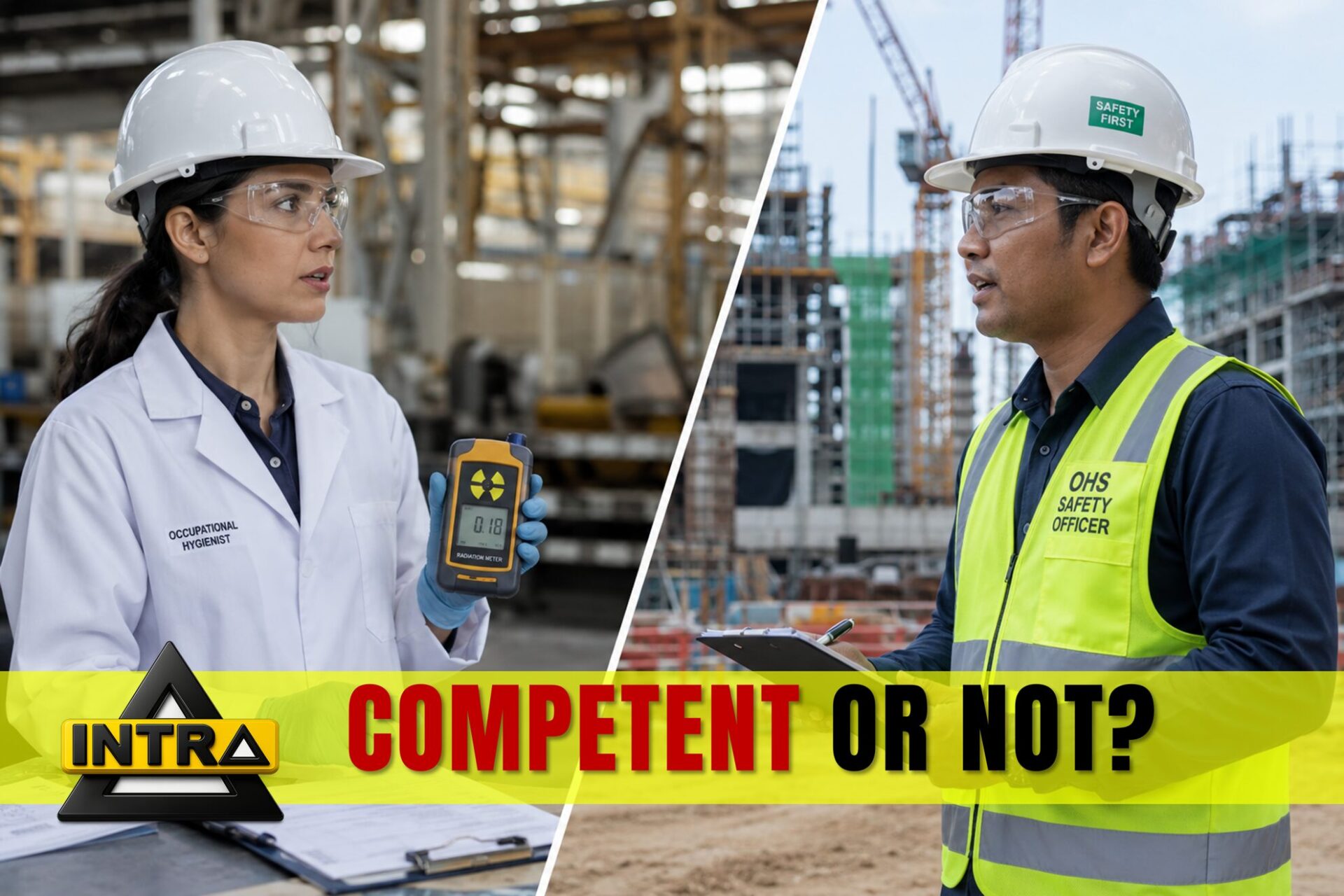
COMPETENCE – MORE THAN A CERTIFICATE
Qualified and Certified – but are they Legally Competent? What Every Employer Needs to Know
Legal, SAQA and Employer Perspectives in South Africa
Author: Ken Annandale | 17 June 2026 | INTRA™ www.intrasafe.co.za
Abstract
The terms Competent Person”, Competence and “Competency” appear throughout South African legislation, South African Qualifications Authority (SAQA) frameworks, Department of Employment and Labour (DEL) guidance documents, Department of Higher Education and Training (DHET) publications and industry standards.
Although widely used, their meaning varies according to the legal, educational, professional and regulatory context in which they are applied.
This article examines the principal legal and educational interpretations of Competence and explains why Competence is not established by qualifications alone, but through an appropriate combination of knowledge, training, skills, experience and demonstrated ability.
Comments, professional opinions, corrections and additional insights are welcomed and encouraged.
1. Introduction
Competence underpins employment, occupational health and safety, education, training and professional registration in South Africa.
Various regulations selectively require employers to appoint Competent Persons to perform Risk Assessment, medical surveillance, inspections, monitoring, training, investigations and technical evaluations
The challenge is that there is no single universal definition of Competence or Competent Person
Some Occupational Health and Safety Act 85 of 1993 (OHSA) regulations contain detailed definitions, while others use the term without defining it. As a result, Competence requirements must often be interpreted within the context of the specific legislation being applied.
Different OHSA regulations define Competence differently.
Various regulations place differing emphasis on qualifications, experience, assessment and workplace performance. Consequently, employers and OHS practitioners must understand how Competence is interpreted in realistic legal, operational and educational environments.
2. The DEL “Competent Person” Guideline
This Guideline provides useful practical guidance on the determination of Competence.
It makes it clear that the employer or their authorised nominee bears the responsibility for evaluating and deciding whether a person is competent to perform a particular function, taking into account the hazards, risks and complexity of the work involved. It further recognises that Competence is a shared responsibility, while individuals should not accept appointments beyond their own level of knowledge, training, skill and experience.
In some circumstances, Competence may require a multidisciplinary approach involving more than one specialist top perform the task.
3. Dictionary Definitions
Dictionary definitions describe Competence as possessing the “ability, qualities or capacity” necessary to perform a task successfully.
While useful as a linguistic starting point, these definitions lack the legal specificity required for statutory appointments under Occupational Health and Safety legislation.
4. Applied Competence
SAQA approaches Competence through the concept of “Applied Competence” comprising:
- Foundational Competence addresses knowledge and understanding.
- Practical Competence addresses the ability to perform tasks.
- Reflexive Competence addresses judgement, learning and adaptation.
5. “Certificate of Competency” versus “Declaration of Competence”
NQF Competence is demonstrated through assessment, portfolios of evidence, workplace observation and practical performance for a learner to be declared COMPETENT or NOT YET COMPETENT.
A Certificate of Competency confirms that prescribed educational, examination or assessment requirements have been met.
However, a certificate does not automatically establish ongoing Competence.
Competence must continue to be demonstrated through workplace performance, sound judgement, practical application, continuing professional development, ongoing workplace exposure and, where appropriate, periodic reassessment.
Competence carries legal implications and potential liability, particularly where legislation specifically requires a task to be performed by a Competent Person.
6. Competence Under OHSA
The OHSA and certain regulations require the appointment of Competent Persons.
Once again, common competency requirements include knowledge, training, experience, skills and where appropriate, relevant qualifications.
The emphasis is not on academic achievement alone but on the ability to perform a specific function safely and effectively.
Regulations such as the Asbestos Abatement Regulations, Ergonomics Regulations, Hazardous Chemical Agents Regulations and Physical Agents Regulations rely heavily on Competent Person appointments.
7. EMPLOYERS are Responsible for Determining Competence
EMPLOYERS or their nominated appointees bear the primary responsibility for appointing Competent Persons where required by legislation.
Competency criteria should consider the specific workplace, hazard profile, risk exposure, complexity of the task, relevant training, qualifications, experience and any applicable legal requirements.
Importantly, employers should be able to justify and defend their competency determinations if challenged by inspectors, auditors, clients, employees, professional bodies or a court of law.
Failure to appoint a genuinely Competent Person may result in inadequate risk management, non-compliance, enforcement action, civil liability, reputational damage and, in some circumstances, criminal consequences.
The appointment of a Competent Person is therefore not merely an administrative exercise but a critical legal and operational responsibility.
8. PAR (Physical Agents Regulations) Trainer Workshop
INTRA™ hosts a 2-part 7-hour Zoom PAR (Physical Agents Regulations) Trainer Workshop designed to create awareness amongst employers, facilitators, managers and OHS professionals.
- Part 1 – Intro to Occupational Hygiene.
- Part 2 – PAR Awareness https://intrasafe.co.za/product/physical-agents-regulations-2024-workshop/
9. What Evidence Supports Competence?
Competence is evidenced rather than declared.
Relevant evidence may include tertiary qualifications, certificates, workplace experience, project histories, assessments, portfolios of evidence, references, testimonials, mentoring records and practical demonstrations.
The stronger the evidence base, the easier it becomes to justify and defend a competency determination.
Workplace expertise should not be confused with Occupational Hygiene Competence.
A practitioner may be highly Competent in legal matters, yet lack the specialised scientific, technical and occupational hygiene knowledge required to conduct a PAR Exposure Risk Assessment.
Is an OHS Practitioner permitted conduct all the required Risk Assessment?
OHS Practitioner may be competent to conduct certain Risk Assessments within the scope of their knowledge, training, skills and experience. However, Competence in one area does not automatically establish Competence in all areas.
The assessment of workplace exposure to physical agents such as Electromagnetic Fields, Ergonomics, Hand-Arm Vibration, Humidity, Illumination, Indoor Air Quality, Noise, Non-Ionising Radiation, Optical Radiation, Pressure, Temperature, Ventilation, Whole-Body Vibration, etc., typically falls within the Competence of suitably qualified and experienced Occupational Hygiene Practitioners or other appropriately Competent specialists, not OHS generalists.
Competence therefore requires a balanced consideration of academic achievement, training, workplace exposure and demonstrated performance.
In Occupational Hygiene, evidence of Competence may include professional registration or certification through recognised professional bodies such as SAIOH.
However, professional recognition should not be confused with statutory approvals that may be required for specific regulated services.
10. Professional Registration, DEL Approval, Accreditation and Competence
Professional Registration, SETA or QCTO certification and Competence are related but distinct concepts.
Registration or accreditation may be required by legislation, industry standards, clients or employers, but neither automatically establishes Competence for every task or workplace.
For example, Competence in assessing one Physical Agent does not necessarily confer Competence in assessing others.
Similarly, registration as a DEL Approved Inspection Authority (AIA) in a specific discipline does not automatically demonstrate Competence across the full spectrum of occupational physical agents or hygiene hazards.
Professional registration, qualifications and certifications may provide evidence of Competence, but none constitute conclusive proof of Competence.
Each concept must therefore be treated separately by the employer.
11. Competence versus Legal Authorisation
A person may possess the knowledge, training, skill and experience required to perform a particular function yet still require a specific legal approval, registration or authorisation before performing certain regulated services.
For example, where legislation requires exposure monitoring to be conducted by an Approved Inspection Authority (AIA), Competence alone may not satisfy the legal requirement.
Similarly, QCTO accreditation authorises a Skills Development Provider to offer specified programmes but does not automatically establish the Competence of every facilitator, assessor or subject matter expert employed by that provider.
12. Legal Disputes and Locus Standi
Competency disputes arise in appointments, promotions, disciplinary proceedings, contractor management, incident investigations and regulatory enforcement actions.
Questions concerning Competence may affect a person’s authority to perform statutory functions and their legal standing in disputes.
Competency assessments should therefore be objective, documented and evidence-based.
13. PAR (Physical Agents Regulations) Trainer Workshop
INTRA™ hosts a 2-part 7-hour Zoom PAR (Physical Agents Regulations) Trainer Workshop designed to create awareness amongst facilitators, managers and OHS professionals
Part 1 – Intro to Occupational Hygiene.
Part 2 – PAR Awareness https://intrasafe.co.za/product/physical-agents-regulations-2024-workshop/
14. Frequently Asked Questions
What is a Competent Person? A person possessing the knowledge, training, skills, qualifications and experience necessary for a specific task.
Who decides whether a person is “competent”? The employer ultimately determines Competence for workplace appointments, taking account of hazards, risks and complexity. However, individuals also have a right and responsibility not to accept appointments beyond their Competence.
Can an employee declare themselves Competent? During recruitment, appointment or assessment processes, an employee may claim or represent that they are Competent to perform a particular function, however Competence must be supported by evidence and accepted by the employer.
Does a qualification automatically establish Competence? No. Qualifications are evidence but not conclusive proof
Can a training provider declare a learner fully “competent”? No. A training provider, facilitator, assessor or examination body may determine that a learner has achieved Competence against prescribed legislation, SAQA learning outcomes, standards, qualifications or assessment criteria as COMPETENT or NOT YET COMPETENT.
However, as the provider is typically unfamiliar with the learner’s specific workplace hazards, risks and operating conditions, it cannot ordinarily determine full workplace Competence.
For example, a learner may successfully complete a counterbalance forklift operator assessment and receive a certificate or licence, yet still require workplace-specific training, supervision and experience before being regarded as Competent by the employer to operate a forklift.
Does professional registration establish Competence ? Not automatically.
What evidence supports Competence ? Qualifications, experience, assessments, portfolios, references and demonstrated workplace performance.
Can Competence be lost? Yes. Competence is not necessarily permanent.
Changes in legislation, technology, standards, workplace processes and prolonged absence from a particular activity may require refresher training, reassessment, supervision or continuing professional development to maintain Competence.
15. Conclusion
Competence is not a qualification, title, registration or self-declaration.
It is a legally defensible determination based on knowledge, training, skills, experience; qualification and demonstrated ability in relation to a specific task, workplace hazard or statutory duty.
South African legislation, SAQA frameworks and DEL guidance consistently indicate that Competence must be evaluated against the work being performed.
Ultimately, Competence must be evidenced, assessed, demonstrated and defended.
The concept of Competence is far more nuanced than simply holding a qualification, certificate, accreditation or professional registration.
As legislation, standards and workplace risks continue to evolve, employers and practitioners should strive to develop and maintain genuine Competence through ongoing learning, practical experience and professional development.
It is hoped this article contributes to a broader discussion on the subject.
Readers are encouraged to share their views, experiences and alternative interpretations
While every effort has been made to present the subject accurately, the author is not a legal practitioner.
Readers are therefore encouraged to consult a suitably qualified legal advisor with extensive knowledge of occupational health and safety legislation when interpreting or applying the law to their particular circumstances.
Ultimately, a well-informed and competent workforce remains one of the most effective foundations for achieving safer, healthier and more productive workplaces.
16. About INTRA™
INTRA™ is a South African Occupational Health and Safety franchise like business support organisation that has licensed and assisted more than 300 organisations, consultants and training providers over the past 15 years to conduct their own Health and Safety training.
Through its STARTER, BASIC, PRIME and PLATINUM Licence options, INTRA™ provides access to customisable aligned OHS training materials, trainer development, eLearning resources, business support and QCTO accreditation know-how.
The objective is to help trainers and organisations reduce development time, improve compliance, build sustainable training operations and ultimately contribute to the prevention of workplace injuries, illnesses and occupational diseases
More info on www.intrasafe.co.za


